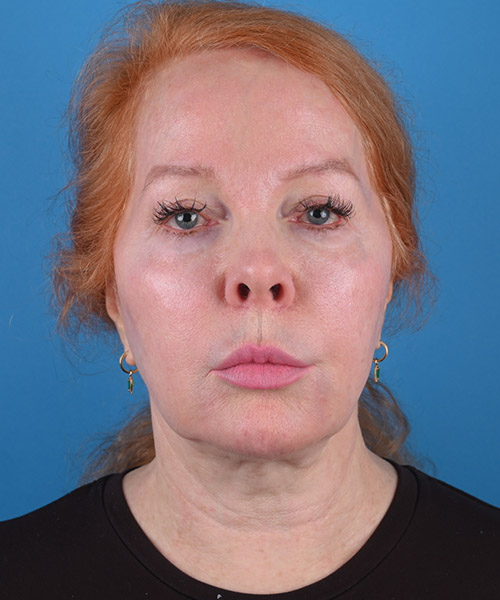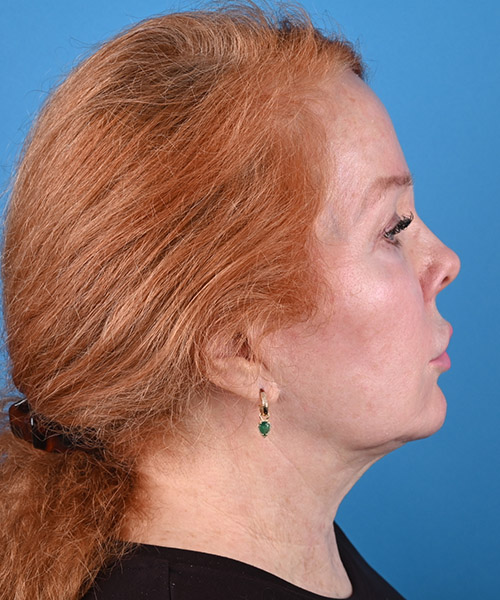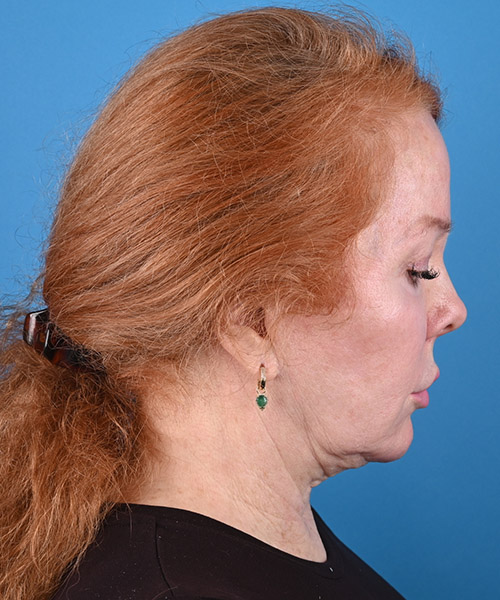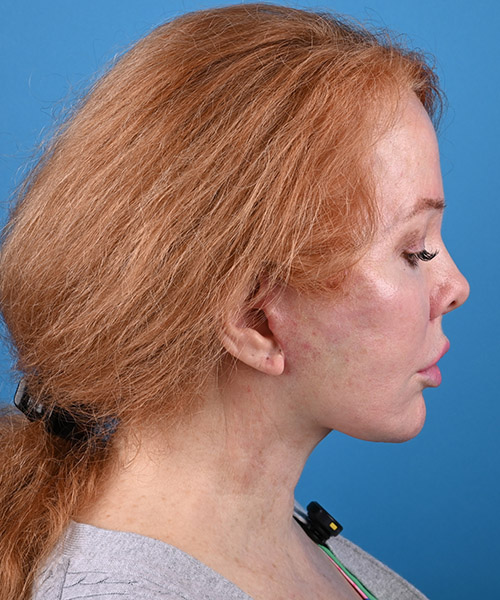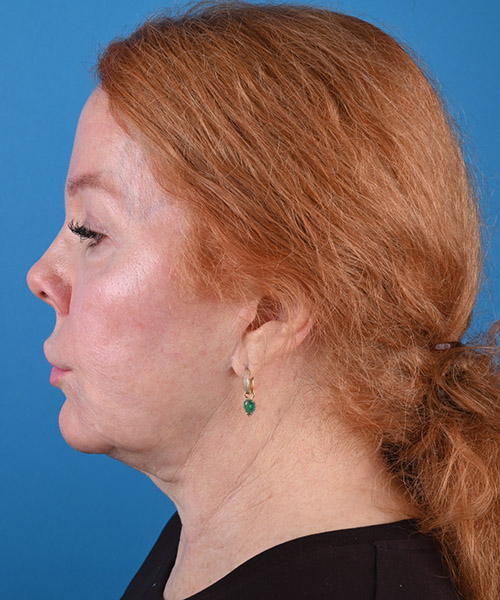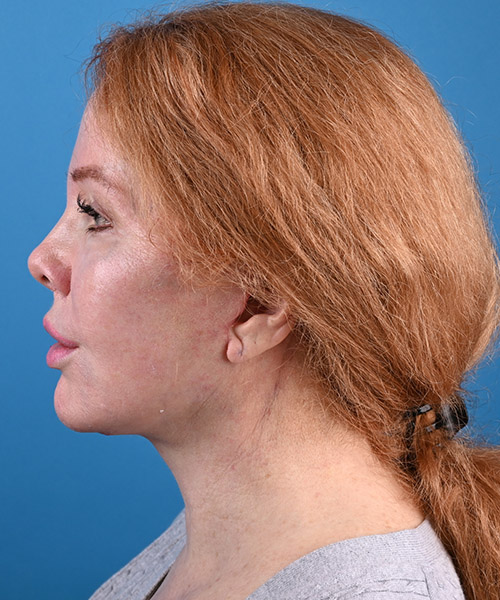








Secondary (Revision) Deep Plane Facelift & Neck Lift
Patient Profile: Female patient in her 60s, presenting 15 years after a previous lateral SMAS facelift, with recurrent soft tissue descent of the midface, jowling, loss of jawline definition, and an undefined neck contour.
Procedure: This patient underwent a secondary deep plane facelift with neck lift to address the natural progression of aging following her prior surgery. Because revision facelift surgery involves previously altered anatomy and scar tissue, a deep plane approach was selected to more effectively reposition descended facial tissue as a composite unit, rather than relying on skin tension alone.
To achieve optimal neck contouring, the procedure also included:
- Submandibular gland reduction — partial removal to correct visible gland bulging, a common contributor to neck fullness that isn’t addressed by skin tightening alone
- Digastric muscle contouring — refining the central neck angle for a smoother, more defined submental region
Result: Photographed on postoperative day 6, the results demonstrate restoration of midface volume in the malar (cheek) region, improved jawline definition, and a smooth, well-contoured neck — with continued refinement expected as postoperative swelling resolves over the following weeks to months.
Why This Matters: Revision facelift surgery requires a different surgical strategy than a first-time facelift. This case illustrates how addressing deeper structures — not just skin and superficial tissue — can meaningfully improve both facial volume and neck contour, even in patients who have had previous facelift surgery.
Individual results vary. This patient is shown at an early postoperative stage; final results are typically assessed at 6–12 months.